| |
THIS WEEK'S KEYS:Pulse: Where AI Capital Actually Lands Playbook: How Family Offices Are Reshaping The Lower Middle Market Spotlight: The Business Behind Clean Buildings Roundup: This Week’s M&A Highlights
Have a great weekend! | | |
| | | PULSE Where AI Capital Actually Lands |  | | |
|
|
|---|
The scale of AI infrastructure investment is difficult to overstate. According to J.P. Morgan Asset Management, AI-related capital expenditures contributed 1.1% to US GDP growth in the first half of 2025, outpacing the American consumer as an engine of economic expansion. Meta, Alphabet, Microsoft, Amazon and Oracle are on track to collectively deploy over $342 billion in capital spending this year, a 62% jump from 2024, with Goldman Sachs projecting that figure could surpass $527 billion in 2026. That capital has to go somewhere, and a significant portion of it is flowing directly into physical infrastructure that lower middle market operators are being paid to build and maintain.
Data centers are the backbone of the AI economy, and building them requires licensed tradespeople. Every hyperscaler facility demands high-voltage electrical installation, industrial HVAC and cooling systems, plumbing and fire suppression infrastructure and ongoing mechanical maintenance. These are not contracts going to large national firms exclusively. Regional electrical contractors, HVAC operators and mechanical services companies in markets where data center construction is concentrated are seeing a meaningful and durable demand tailwind. For LMM operators with the certifications, capacity and geographic positioning to serve these projects, AI capex is translating into a backlog.
The scale of that opportunity is compounding. A Goldman Sachs Research report projects hyperscaler spending could surpass $527 billion in 2026, and the physical footprint of that investment is concentrated in specific markets. Data center construction in the US has accelerated across Virginia, Texas, Arizona, Georgia and the Pacific Northwest, markets where regional trade contractors are already embedded and positioned to capture incremental work. According to CBRE, data center construction in the US reached a record 3.3 gigawatts in 2024, a 70% increase from the prior year, putting direct pressure on the regional electrical, HVAC and mechanical contractors needed to build and commission that capacity. For investors underwriting trade services platforms in these geographies, the AI capex wave is not a macro abstraction. It is a demand input worth building directly into the thesis.
The concentration risk is real. Natixis Investment Managers cautions that the boom is driven by a handful of hyperscalers rather than broadly diffused across the economy, and Real Investment Advice notes that stripping out AI capex would reveal US growth significantly weaker than advertised. For LMM operators whose revenue becomes heavily dependent on a single data center developer or hyperscaler subcontract, customer concentration risk is a genuine underwriting consideration.
The broader takeaway for operators and investors is this: the AI infrastructure buildout is a generational capital cycle, and lower middle market trade contractors are among the most direct and underappreciated beneficiaries. The firms that position now with the right certifications, labor capacity and geographic focus will be best placed to capture a demand wave that, based on current spending projections, is still in its early innings. |
| | | PLAYBOOK How Family Offices Are Reshaping the Lower Middle Market |  | Photo by Argent Financial
|
|
Family offices have quietly become one of the most consequential forces in the lower middle market, and operators and private equity firms not paying attention risk missing a structural shift in how deals get done.
The capital behind that shift is substantial. Deloitte estimates that in 2024, family offices managed a combined $3.1 trillion in assets, reflecting a 63% increase from 2019. That capital is flowing directly into the $5 million to $50 million EBITDA deal space that institutional PE firms have historically dominated. Axial's platform alone lists 578 family offices actively sourcing lower middle market transactions, a figure that illustrates how dramatically the competitive landscape has changed over the past decade.
What makes this shift significant is not just the volume of capital but how family offices show up differently at the table. According to BNY's 2025 Investment Insights for Single Family Offices, there has been a 52% year-over-year increase in family offices citing alignment of interests as a crucial deal consideration. Where PE funds target three to five year hold periods, family offices hold for seven to fifteen years, prioritizing multi-generational compounding over short-term IRR. That is a fundamentally different mandate and it produces a fundamentally different kind of partner.
For founder-owned and family-run businesses, that difference matters. Family offices offer continuity of culture, greater flexibility on deal structure and a buyer who is not planning a quick flip, which is precisely what many sellers are looking for. Intermediaries are increasingly bridging the gap, connecting operators with family office capital in ways that allow families to move at PE speed without PE overhead.
The forward indicators reinforce the trend. Goldman Sachs' 2025 Family Office Investment Insights report found that nearly 40% of family offices plan to increase their private equity allocations in the next twelve months. In the lower middle market, where roll-ups already account for over 80% of all deals, family offices are entering the consolidation game directly and with staying power.
Family offices are not a softer alternative to PE. They are a structurally different kind of capital with longer runways, relationship-driven sourcing and a hold period that aligns naturally with how founder-led businesses are actually built. Understanding how they underwrite and what they value is no longer optional context in the lower middle market. It is a core part of the playbook. |
|
|
|
|---|
|
| |  | Photo by Adobe Stock Images |
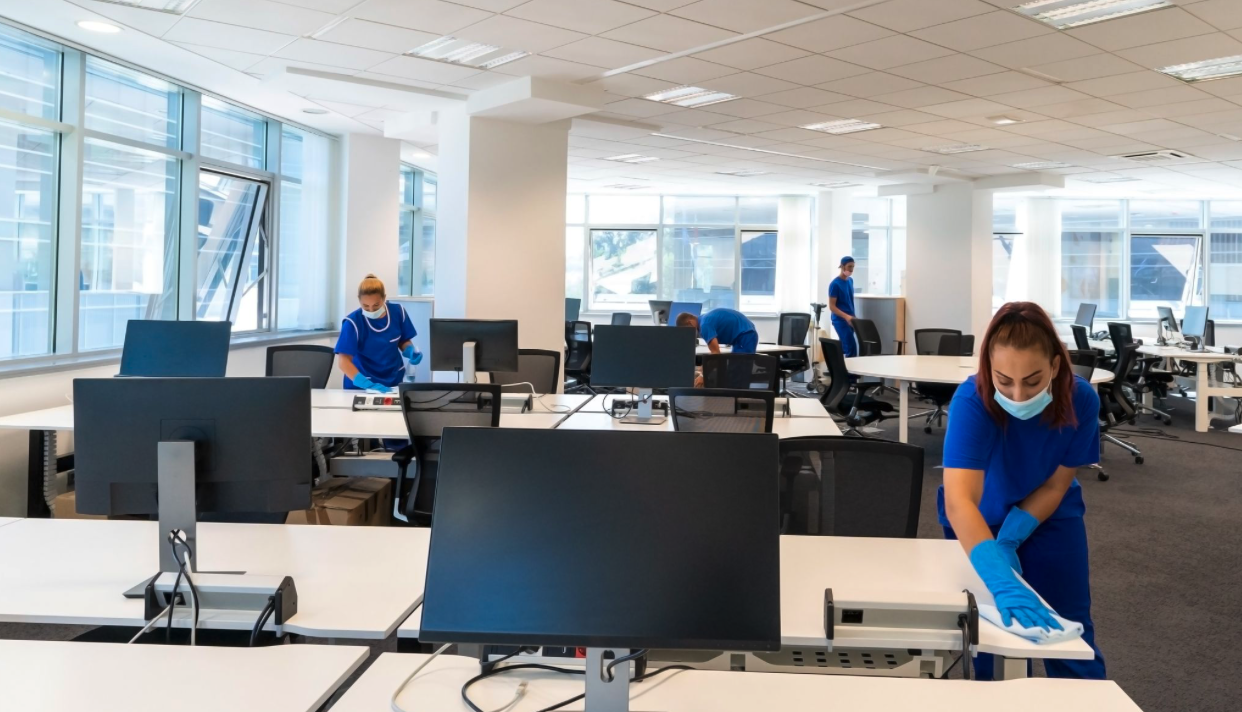
| Environmental services teams rarely make headlines, but the work they do shapes every clean, safe and functional space people walk into each day. In hospitals, offices, schools and transit hubs, these workers keep environments sanitary, reduce infection risks and help facilities run the way they are supposed to. For lower middle market operators in commercial cleaning and janitorial services, that work represents a durable, recurring revenue business built on contracts that renew because the need never goes away. Nowhere does that demand matter more than in healthcare. Research published in Annals of Internal Medicine found that properly cleaning hard surfaces in hospital rooms plays a meaningful role in reducing healthcare-associated infections. In a hospital, environmental services teams are not just making rooms look clean. They are helping protect patients, families and staff from real, preventable harm, and that criticality translates directly into contract stickiness for the operators serving those facilities.
The industry is changing fast. Staffing shortages, higher cleanliness expectations and new technology are pushing departments to operate in ways that look significantly different from just a few years ago. Turnover in the janitorial and building services sector runs as high as 200% annually in some markets, which means retaining and developing talent has become as important as hiring it. For lower middle market operators, that turnover dynamic is both the central operational challenge and a meaningful competitive moat. Companies that solve the retention problem at scale, through better training, career development and workforce systems, are building something that fragmented local competitors cannot easily replicate. Environmental services have quietly outgrown their old reputation. This is no longer just about appearances. It is about resilience, safety and whether people can actually trust the spaces they occupy.
Strong environmental services programs combine the right systems with people who know how to use them. Better scheduling, smarter tracking and targeted training all contribute, but none of it works without a team that takes the work seriously. Sustainability is now part of that equation as well. Facilities are cutting water use, reducing waste and switching to cleaner products. The global green cleaning products market is projected to surpass $13.4 billion by 2034, a sign that sustainability in this space is moving from preference to expectation. For LMM operators investing in green-certified service offerings, that shift represents both a differentiation opportunity and a pricing lever in an otherwise commoditized market.
That growth reflects something real about what organizations need from their buildings. Health, retention and day-to-day employee experience all connect back to whether spaces are maintained well. Research highlighted by the International WELL Building Institute notes that healthier buildings can improve productivity, reduce absenteeism and create more enjoyable work environments. Facility quality is now directly tied to how employees feel and perform, and the operators responsible for delivering that quality are increasingly being recognized as strategic partners rather than vendors. For investors underwriting commercial cleaning and janitorial platforms in the lower middle market, that shift in how clients value the service is exactly the kind of structural tailwind worth paying attention to. |
|
|
|
|---|
|
| | This Week’s M&A Highlights |  |
|
|
|---|
|
●GI Partners-backed American Residential Services acquired Tipping Hat Plumbing, Heating & Electric, a Denver, CO-based residential heating, cooling, electrical and plumbing services company
●McNally Capital-backed Foundral acquired A. Hattersley & Sons, a Fort Wayne, IN-based mechanical contracting service company
●General Atlantic-backed Flint Group acquired Air Around the Clock, a Deerfield, FL-based HVAC and plumbing services company
●Shore Capital Partners-backed ONDEX Automation acquired The Fitch Company, a Rumford, ME-based electrical engineering and process automation systems integrator
●Apollo Global Management made a minority investment in Apex Service Partners, a national residential HVAC, plumbing and electrical services platform, valuing the company at ~$10B
●Bregal Partners-backed Juniper Landscaping acquired Hilton Head Landscapes, a Hilton Head Island, SC-based landscape maintenance and installation services company
●MYR Group (NASDAQ:MYRG) acquired Valley Holdings, the parent company of Valley Electric Company and Comet Electric, a utility and electrical infrastructure services company for, $328M |
|
|
|---|
|
ABOUT US WestGate Partners | | | WestGate Partners (WGP) is an independent sponsor focused on acquiring and growing lower middle market businesses in essential residential and commercial services. We bring institutional experience, tailored capital with hands-on partnership to help owners transition, grow and preserve their legacy. By partnering with strong operators, we build enduring businesses in economically-insulated industries. |
|
|
|
|---|
|
For more information, please visit: |
|
|
| | |
|---|
|
|